
By Dr Detlof von Oertzen
Namibia’s green industrialisation ambitions – unless off the grid – are primarily a transmission question. So are on-grid production of hydrogen and ammonia, and regional electricity exports.
Industrialisation hinges on affordable electricity delivered when and where it is to be consumed. Investors need confidence that contracted energy can be delivered. Consumers value reliable supplies when needed. Exporters rely on secure cross-border networks. It is the transmission network, i.e. the high-voltage grid, which is the binding link.
Constraints
Namibia’s power utility, NamPower, operates more than 12,000 kilometres of transmission network. Yet, in 2026, less than half of the country’s population has access to grid electricity. That is roughly 125 people per transmission kilometre, who paid to create it, operate it, and maintain it.
For comparison, in South Africa, the number stands at 1,900 people per kilometre of transmission network. Namibia’s challenge is the long grid relying on a tiny revenue base.
Firm domestic generation does not cover Namibia’s peak demand. Imports are used to fill the gap. Regional networks add flexibility, but they also imply additional risk.
Neighbouring systems have faced sustained shortages, driven by drought, underinvestment, mismanagement, and fuel costs. Yet, in recent years, Namibia’s interconnectors ensured that grid-connected customers enjoyed stable supplies.
There is a lesson to be learnt: diversified import contracts, and a prudently funded and well-managed utility kept Namibian customers supplied. Not grandiose notions of self-sufficiency.
Geography adds another complication. Major generators are seldom near demand centres. Namibia’s co-located world-class solar and wind resources are far away from existing load centres. Cheap power plant are often costly if they require long network connections. When networks are constrained, contracted load is curtailed and productive plant stands idle.
Funding for the expansion of the transmission network is limited. Cash flow generated from the network is often inadequate to finance large or long-term grid expansion. Concessional finance can be a catalyst, but does not replace sound revenue.
When the regulator disallows a utility’s revenue requirements, it constrains maintenance and defers expansion. Keeping transmission capped means that we must live with its constraints, and industrialisation simply will not happen.
Opportunities
Namibia currently uses its transmission capacity to bridge the gap between national demand and local supply.
Regional interconnectors, however, can turn the country into an active trader and transit country. The Zimbabwe-Zambia-Botswana-Namibia (ZIZABONA) line, the Angola-Namibia (ANNA) link, and a new Botswana–Namibia interconnector strengthen access to the Southern African Power Pool (SAPP).
This transfer capacity can earn revenue rather than only create cost. Regional interconnection boosts trade by enabling exchanges of cheap electricity from national endowments: low-cost solar electricity exported from Namibia during the day can be complemented by low-cost hydro-electricity from Zambia and Zimbabwe when hydrological conditions allow.
SAPP’s market rules and transmission pricing methodology provide a rules-based platform, within available transfer capacity, that Namibia can increasingly benefit from as a supplier, trader, and off-taker, leveraging our comparative advantages.
New dispatchable capacity could support the grid when demand peaks or renewable output falls. Flexible generation capacity, as may become available from the Baynes hydro-power plant and/or the Kudu gas-to-power plant, are possible options, noting that neither has reached financial close. Their value is not limited electricity sold, as they would provide reserve capacity, stability and enable the network operator to relieve constrained lines.
New industrial loads, from hydrogen and ammonia to oil‑and‑gas support facilities, must contribute fairly to network costs. Without this, existing customers would carry the full burden of the transmission build‑out that the country needs. Connection and use‑of‑system charges, including wheeling, exist to integrate large users into the grid. Allowing off‑grid operations in exclusion zones strips them of shared responsibilities and undermines national development efforts.
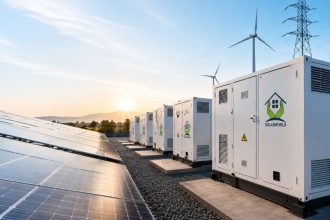
Modern battery energy storage systems (BESS) also change the picture. Namibia’s Omburu BESS (51 MW / 51 MWh) and Lithops BESS (45 MW / 90 MWh) are examples. BESS charges when spare capacity is available, and discharges in periods of high demand. Such systems can provide essential network services, reduce network congestion, and may even defer network upgrades, which holds considerable value when having to expand networks.
While BESS does not remove the need for new lines, it buys time and improves the use of existing assets until a grid upgrade becomes unavoidable.
New generation, including the 100 MW solar PV Sores |Gaib plant, the 40 MW Otjikoto bush-to-electricity plant, and the 80 MW Omburu II PV plant must feed reliable grids.
Namibia’s extensive network ensures that added generation capacity translates into useful electrical energy, for consumption in homes, commerce, and industry, in mines and agriculture, and elsewhere.
Ensuring the grid’s future
From today’s perspective, the following actions matter most:
- Strengthen the utility revenue model: below-cost tariffs and sporadic subsidies lack transparency and create uncertainty. Utilities rely on stable tariff paths from which to recover costs. Ad hoc interventions have no place in the application of a rational tariff methodology.
- Monetise regional integration: use existing and new interconnectors for security, and generate additional income through trade and from transit of electricity.
- Create a market for grid services: pay dispatchable plant, BESS, flexible customers and capable renewable plant for reserve, frequency response, voltage support, and black start capabilities. This diversifies the risk and creates incentives for new investments in the electricity industry.
- Integrate the National Integrated Resource Plan with NamPower’s Transmission Master Plan: generation and network plans must use the same departure point, assumptions, and priorities, for planning to lead to projects that are solidly funded, get built, and generate reliable revenues.
Conclusions
Expanding Namibia’s transmission networks cannot be funded by current users alone. This is why new trade revenue, cost-reflective connection charges and a services market are not optional extras, but the tools to finance the network’s future.
The transmission network is the binding constraint of Namibia’s on-grid industrial ambitions. Strengthening transmission and connecting additional generation and markets, the grid can become the true catalyst of national development.