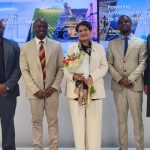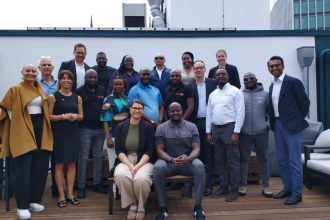
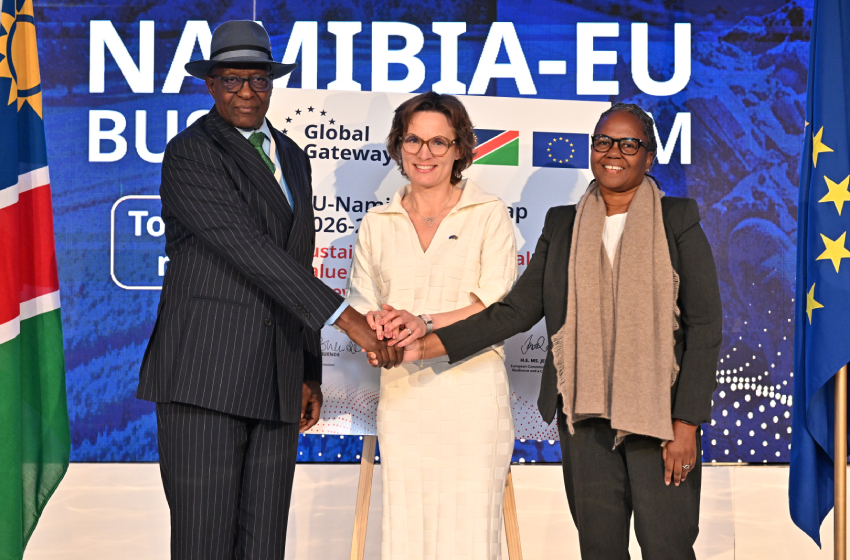
The 2nd Namibia–EU Business Forum took place in Windhoek in May, with European countries reaffirming their continued support to Namibia’s green industrialisation agenda.
European Union Ambassador to Namibia, Ana Beatriz Martins, said as the country was positioning itself as a global leader in green industrialisation, the opportunities for Namibia in the emerging industries cannot be understated.
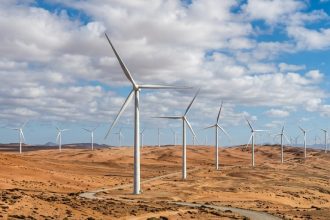
“Because critical raw materials, renewable energies, and green industrial products will shape the global economy for decades to come. Namibia currently has seven to eight large-scale green hydrogen projects in the pipeline, representing an estimated €20 billion (about N$378 billion) in investment potential. What we are witnessing is not simply the emergence of a new sector, but the foundations of a new industrial future,” she said.
Martins said the EU’s Global Gateway initiative offers a powerful platform to deepen Namibia’s transformation and help unlock the scale of investment required to realise the green industrialisation ambitions.
“Namibia’s ambition is not simply to export raw materials, but to move decisively towards greater industrialisation, local processing, and value addition. This is the direction of the future — creating more value locally, generating skilled jobs, strengthening industrial capacity, and ensuring that Namibia captures a greater share of global value chains. Achieving this will require investment, technology transfer, innovation, and strong partnerships between governments and the private sector,” the EU Ambassador said.
The 2nd Namibia-EU Business Forum, which had over 1 000 participants (both in person and online), placed emphasis on green industrialisation, focusing on sustainable critical raw materials value chains, green hydrogen and renewable energies, agribusiness, automotive industry, and the cultural and creative industries, which are key sectors for promoting local value addition, innovation, and investment.
Over three days, the Forum translated the Namibia–EU partnership into concrete action through discussions.
Ambassador Martins said the Forum demonstrated the growing momentum of the Namibia–EU partnership and the shared commitment to creating jobs, expanding industries, and building sustainable economic growth.
The Forum also reflected on the success of the EU–SADC Economic Partnership Agreement (EPA), which marks its tenth anniversary since its signing in June 2016.
Over the past decade, Namibia–EU trade has doubled to N$17.6 billion, with exports ranging from mining and fisheries to agriculture, beef and charcoal. Preliminary estimates show that approximately 46,762 Namibian jobs are directly linked to exports of goods to the EU alone. This does not yet include services such as tourism, which support thousands of additional jobs around the country.
In addition, proposed cooperation between European and Namibian partners in ports and rail could unlock significant new investment and strengthen Namibia’s position as a regional trade gateway.
The Forum concluded with several important announcements and signing ceremonies aimed at supporting Namibia’s long-term economic transformation and green industrial ambitions:
- The “Making Lüderitz Town Council Fit for the Future” project will help prepare the town of Lüderitz for future investment, economic expansion and urban growth. The project will be implemented by the Association of Netherlands Municipalities (VNG) in partnership with the Lüderitz Town Council, with an EU contribution of €1.5 million (N$29 million) and Netherlands contribution of €308.000 over two and a half years.
- The “Support to the Namibian Standards Institute” project will strengthen standards development for emerging green industries and enhance Namibia’s industrial competitiveness. The initiative will be implemented by the German National Metrology Institute (PTB) in partnership with the Namibian Standards Institution (NSI), with a total budget of €750,000 (N$14.5 million) over two years.
- The Namibia window of the EU Pan-African Support to Geological Sciences and Technology (PanAfGeo+) programme, together with the German Federal Institute for Geosciences and Natural Resources (BGR), will support implementation of the critical raw materials value chains leg of the EU–Namibia partnership through coordination, knowledge management, and improved access to geoscience-related equipment. The project carries a budget of €1.8 million (N$35 million) over two years.
- The National Critical Raw Materials Strategy project will support the development of Namibia’s National Critical Raw Materials Strategy, including policy, legal, institutional and investment frameworks for exploration, beneficiation and circular economy integration. The project has a budget of €386,860 (N$7.5 million) over 12 months.
- The Forum also announced plans for the upcoming Green Industries Summit, scheduled to take place in Swakopmund in September 2026. The Summit is expected to further position Namibia as one of Africa’s leading destinations for green industrial investment and strategic partnerships.
The successful conclusion of the 2nd Namibia–EU Business Forum marks another major step forward in strengthening Namibia–EU cooperation, expanding trade and investment ties, and positioning Namibia as a leading destination for sustainable investment, green industrialisation and long-term economic growth in Africa.