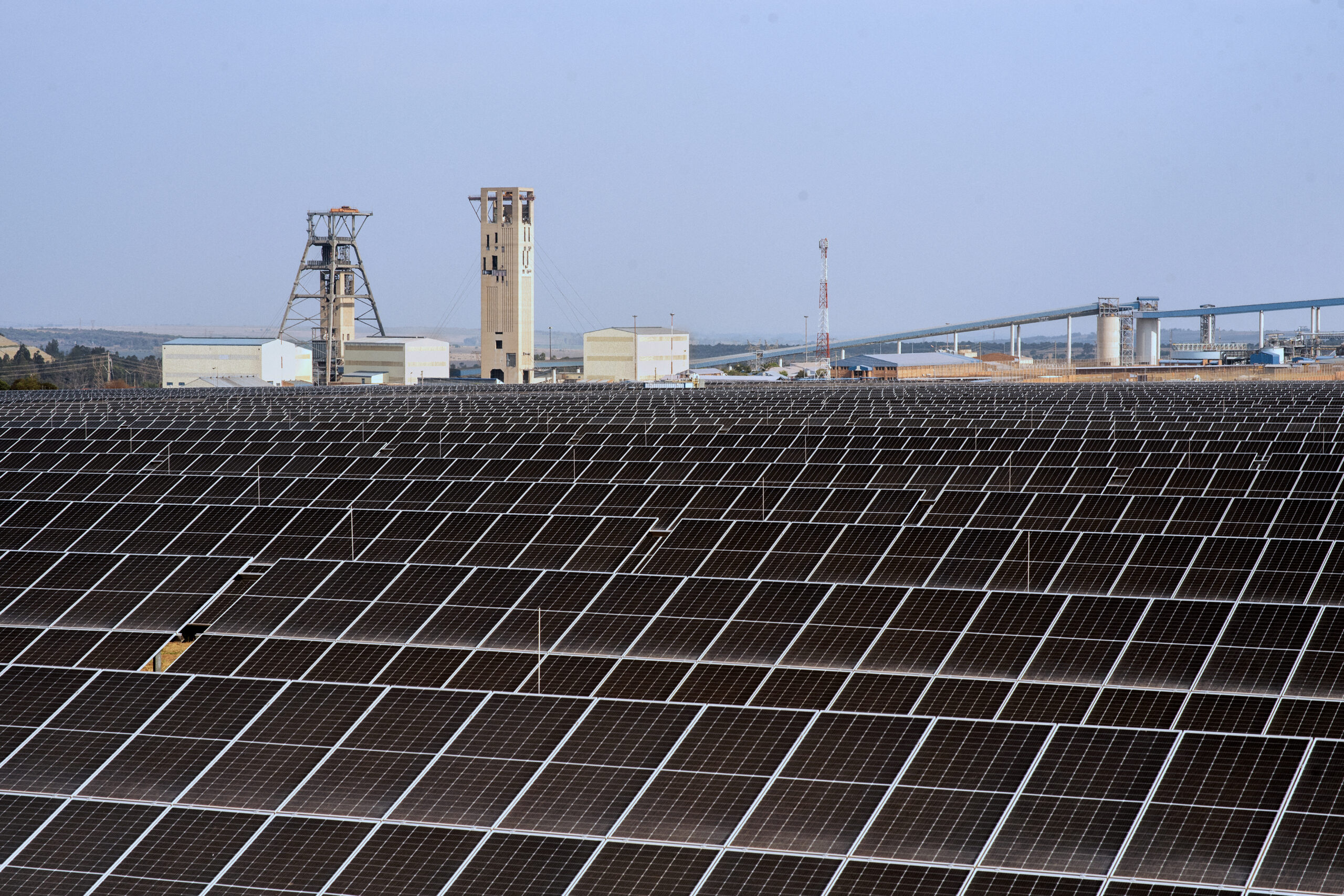
Africa is widely regarded as one of the most promising frontiers for solar energy development anywhere in the world.
The continent holds some of the planet’s highest levels of solar irradiation, a fast-growing population that is only partially connected to reliable electricity, and an economy where diesel generation and grid outages remain a daily cost of doing business.
Against that backdrop, solar power — increasingly paired with battery storage — has moved from a niche or donor-funded technology to a mainstream investment category attracting utilities, mining houses, manufacturers, and private households alike.
According to the Global Solar Council (GSC), Africa recorded its fastest year of solar growth on record in 2025, with new solar photovoltaic (PV) installations rising 54% year-on-year to reach approximately 4.5 gigawatts (GW) of new capacity.
The Africa Solar Industry Association (AFSIA) separately reported that the continent’s cumulative operational solar capacity — spanning utility-scale plants, commercial and industrial (C&I) systems, mini-grids, and solar home systems — surpassed 20 GW during 2025, up from about 19.2 GW at the end of 2024.
Africa’s solar advantage begins with geography. Much of the continent — particularly the Sahara, the Sahel, the Kalahari and Namib deserts, and large parts of Southern and East Africa — sits within what is often described as the world’s largest cloud-free area, receiving some of the highest and most consistent solar irradiation levels on Earth.
Yet an estimated 600 million people across the continent still lack reliable access to electricity, according to figures cited in recent academic reviews of Africa’s energy transition. The African Union has set a goal of universal electricity access by 2030, a target the World Bank-backed Mission 300 initiative is also working toward, aiming to connect 300 million Africans to power by the end of the decade.
Solar is central to closing that gap for a simple reason: it is now the fastest technology to deploy and, in most markets, the cheapest new source of generation available — a combination that is difficult for any competing technology to match at the pace Africa’s demand is growing.
Current State of Solar Energy in Africa
Africa’s solar market today is really two markets growing in parallel. The first is utility-scale, publicly procured or development-finance-backed generation — large solar parks feeding national grids.
The second is a rapidly expanding, privately financed layer of commercial, industrial, and residential rooftop solar, plus mini-grids and off-grid solar home systems serving communities beyond the reach of national grids.
GSC data indicates utility-scale projects accounted for roughly 56% of Africa’s newly installed solar capacity in 2025, with distributed solar — rooftop, C&I, and residential — making up an estimated 44%, though the true distributed share is likely higher because small-scale systems are harder to track in official statistics.
AFSIA has noted that Africa imported some 18.2 GW worth of solar modules in 2025 alone, far exceeding what utility-scale projects can account for, which points to a large and rapidly growing rooftop and captive-power segment that current data likely undercounts.
Selected country snapshots
South Africa remains the continent’s largest solar market by a wide margin, accounting for roughly half of Africa’s cumulative installed solar capacity.
Its Renewable Energy Independent Power Producer Procurement Programme (REIPPPP) has driven both utility-scale solar farms and a boom in rooftop installation, and the country added around 1.6 GW of new solar capacity in 2025 alone — the largest single-country addition on the continent.
Namibia, Ghana, Nigeria, Zambia, and Rwanda each added meaningful new solar capacity in 2025; Nigeria’s 803 MW of additions made it the second-largest single-country contributor to Africa’s 2025 growth, behind only South Africa.
Technologies Driving Growth
The core technology remains solar photovoltaic (PV) panels, which convert sunlight directly into electricity. Monocrystalline panels, made from a single silicon crystal, offer higher efficiency and perform better in high-temperature African conditions, while polycrystalline panels remain a lower-cost option still used in some price-sensitive segments.
On the power-conversion side, string inverters dominate smaller commercial and residential systems, while central inverters are typically used on larger utility-scale plants.
Hybrid systems — combining solar PV with battery storage and, in some cases, diesel backup — are becoming the default configuration for commercial and industrial users seeking to avoid grid outages altogether rather than merely supplement grid power.
Smart energy management software and grid-modernisation investments are increasingly bundled with new projects to help utilities and site operators optimise how solar and storage assets are dispatched.
Two more specialised technologies are gaining early traction. Floating solar — PV panels installed on reservoirs and dam surfaces — has been deployed at pilot and small-commercial scale in countries including Ghana, where a floating installation sits on the Bui Dam reservoir.
Agrivoltaics, which combines solar generation with agricultural land use beneath or around the panels, remains an emerging concept in Africa rather than a mainstream one, though interest is growing given the continent’s land-use and irrigation needs.
The Role of Battery Storage
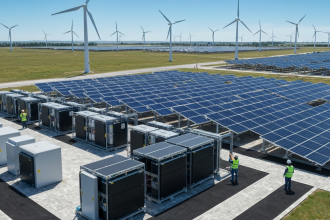
Battery Energy Storage Systems (BESS) have moved from an optional add-on to what many industry participants now describe as an essential component of new solar projects in Africa.
Storage addresses solar power’s core limitation — that generation only happens during daylight hours — by shifting stored daytime energy into the evening and night, when demand often peaks.
BESS also performs a second, increasingly important function: grid stabilisation. As more variable renewable generation connects to African grids and older thermal plants are retired or run less often, storage can inject or absorb power rapidly to manage frequency, reduce network congestion, and cut the technical losses associated with long-distance transmission — services South Africa’s Eskom has specifically highlighted as BESS use cases on its own grid.
Costs have fallen sharply. Recent industry analysis cited in the Africa Solar Outlook 2026 report puts the cost of converting daytime solar into fully dispatchable, round-the-clock power at around US$33 per megawatt-hour using current storage technology — a level that has enabled projects such as a 100 MW solar-plus-storage plant in Mauritius to deliver reliable power at roughly 7 US cents per kilowatt-hour, a price once considered unachievable for solar with storage in Africa.
The scale of the buildout ahead is significant. Market intelligence firm Rho Motion has projected that installed BESS capacity across Africa could grow by as much as 700% between 2025 and 2030, with South Africa leading both in the number of projects and in installed capacity.
Major Growth Drivers Through 2035
- Falling equipment costs: continued declines in the price of solar modules and lithium-iron-phosphate battery cells, driven largely by Chinese manufacturing, are making solar-plus-storage cost-competitive with, and often cheaper than, both grid electricity and diesel generation.
- Government policy and procurement programmes.
- Private investment and climate finance.
- Rural electrification programmes.
- Demand from mining, manufacturing, data centres, and telecom infrastructure.
- Electric mobility. – Construction & Civil Engineering magazine