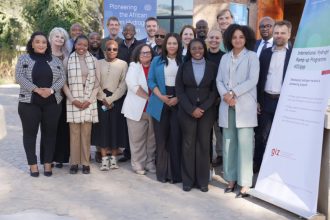
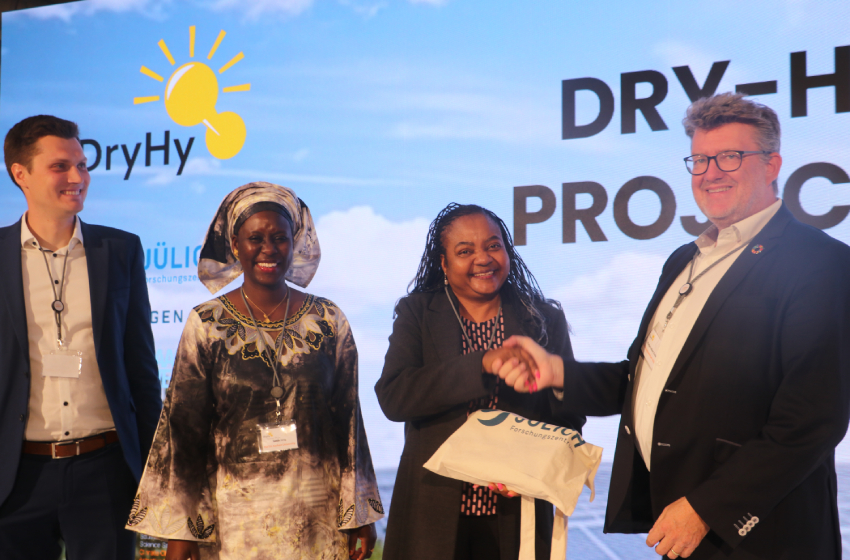
Windhoek, Namibia – Producing green hydrogen without consuming precious freshwater – that vision brought researchers, policymakers and industry leaders together in Windhoek on 18 June, where the partners of the DryHy project, and the Southern African Science Service Centre for Climate Change and Adaptive Land Management (SASSCAL) hosted a workshop on the DryHy Research Project.
More than a technical meeting, the event highlighted how international collaboration could help reshape the future of clean energy production in arid regions.
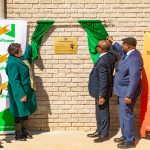
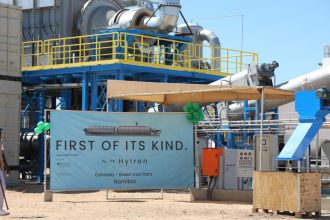
The workshop followed visits by the German delegation to two of Namibia’s flagship green hydrogen initiatives—Cleanergy Solutions Namibia and the Daures Green Hydrogen Village in the Erongo Region—where participants observed first-hand how Namibia is positioning itself as a pioneer in renewable hydrogen development.
At the center of DryHy is a simple question: How can green hydrogen carriers like methanol be produced in deserts without competing for scarce water resources?
WATER OBSTACLE
Conventional hydrogen production through electrolysis requires large quantities of purified water, presenting a significant challenge in water-stressed countries such as Namibia. DryHy seeks to overcome this obstacle by combining three advanced technologies: Direct Air Capture (DAC), Solid Oxide Electrolysis Cells (SOEC) and a methanol reactor.
Instead of relying on freshwater supplies, the system extracts both water vapor and carbon dioxide directly from the atmosphere. Powered by solar energy, high-temperature electrolysis then converts the captured water into hydrogen while converting the carbon dioxide into carbon monoxide.
The mixture of hydrogen and carbon monoxide called synthesis gas can be converted into a variety of value-added products. In the DryHy process it is used to produce methanol—a versatile chemical that can serve as a feedstock for industry or as a sustainable transport fuel.
By integrating these technologies, the project aims to build a demonstration plant to show that green hydrogen and e-fuel production is possible even in some of the world’s driest environments.
SCIENTIFIC PARTNERSHIP
DryHy is a research project involving German research institute, Forschungszentrum Jülich, SASSCAL, RWTH Aachen University, Volkswagen (VW) and FEV Europe. The project is funded by the German Federal Ministry for Research, Technology and Space and seeks to strengthen long-term scientific and energy partnerships between Germany and Africa.
For Namibia, the research aligns closely with national ambitions to become a global producer of green hydrogen while simultaneously creating new industries and expanding domestic energy access.
Nelago Indongo, the Executive Director of SASSCAL, said the DryHy Research Project forms part of Namibia’s broader strategy to position itself as a global green hydrogen export hub while simultaneously addressing domestic energy and industrial development needs. She said the project was best suited to Namibia’s arid conditions.
To ensure the economic feasibility of the project in Africa in the future, economic analyses will accompany technological investigations. This includes a focus on technologies, key stakeholders, potential locations, and necessary markets.
EXPERTISE TRANSFER
The establishment and transfer of expertise are also central components of the project. Involvement of master’s and doctoral students from Africa, academic courses, as well as networking with stakeholders from politics, business, science, and society are integrated into the project to facilitate targeted knowledge transfer.
The Windhoek workshop showcased opportunity to establish local methanol production in high-solar, water-scarce regions. It also revealed the potential for local value creation instead of pure resource export, skills development and operator training, as well as long-term industrial capability building through co-development.
As the project moves toward its next phase, researchers are seeking Namibian industrial partners—including methanol producers, processors and end users—to participate in the development of a pilot plant. Phase 3 will focus on technology transfer and the joint design of both the technical system and its commercial business case, ensuring that local partners play a central role in shaping the technology’s future. For a country defined by sunshine, open landscapes and limited freshwater, DryHy shows how scientific innovation can turn environmental constraints into competitive advantages, positioning Namibia not only as a producer of clean energy, but also as a forerunner for the next generation of sustainable industrial technologies.