President Netumbo Nandi-Ndaitwah has said a clean energy transition must not only be measured in megawatts installed or emissions avoided, but in jobs created, communities connected, skills transferred and industries established.
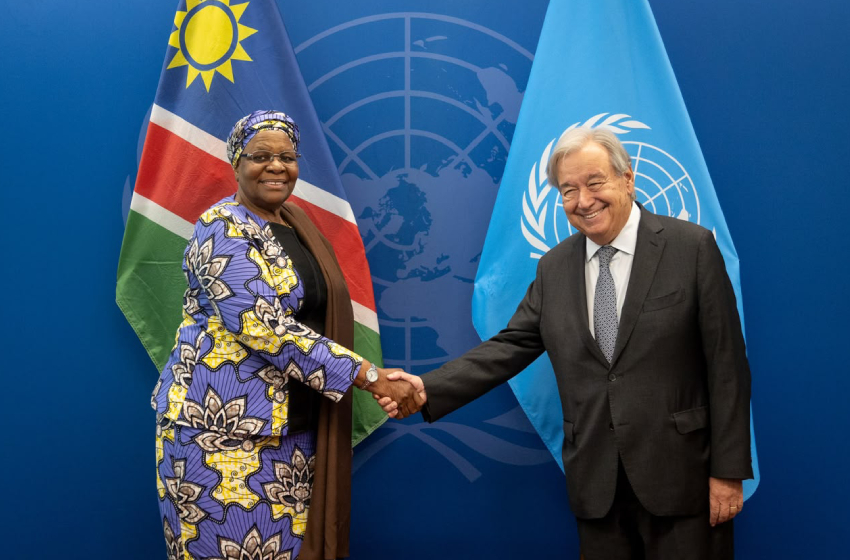
Addressing a high level audience in New York comprised of global business leaders, heads of state and government, and United Nations leadership, including Secretary-General António Guterres, Nandi-Ndaitwah said Namibia approaches the energy transition from the perspective of a developing country.
“We support the objectives of the Paris Agreement and a global pathway towards limiting the increase in temperature to 1.5 degrees Celsius. At the same time, the transition must recognise different national circumstances and safeguard the right of developing countries to industrialise, eradicate poverty and secure universal access to energy. A transition that leaves communities without power, workers without viable alternatives or countries trapped at the bottom of global value chains will neither be durable nor fair,” said the Namibian head of state.
Accelerating Change
Nandi-Ndaitwah said energy policy had become inseparable from economic security, climate resilience and human development, and that the question was no longer whether the global energy system must change, but how that change can be accelerated at the scale and pace required.
“For Namibia, this is not an abstract policy debate. Reliable and affordable energy determines whether a rural clinic can safely preserve medicines, whether a small enterprise can expand, whether a young person can find decent work at home,” said the President.
Nandi-Ndaitwah reminded the global business and UN leadership that energy transition must recognise different national circumstances and safeguard the right of developing countries to industrialise, eradicate poverty and secure universal access to energy.
Diversified Energy System
Nandi-Ndaitwah said Namibia’s national approach was thus anchored on an increasingly diversified energy system, expanded domestic generation and stronger regional integration.
“At continental level, Africa’s energy transition must be an industrialisation strategy. We must use clean energy not only to export electricity or unprocessed minerals, but to manufacture, beneficiate, strengthen food systems, modernise transport and create skilled workforce,” said the Namibian leader.
Nandi-Ndaitwah, however, emphasised that it remained the government’s responsibility to provide direction, predictability and enabling infrastructure, while the private sector must bring investment, innovation and responsible execution.
“The United Nations, development finance institutions and international partners must help align standards, mobilise finance and strengthen cooperation,” she said.
During the Unstoppable Africa 2026 meeting in New York, Nandi-Ndaitwah joined Veronica Bolton Smith, Founder and CEO of Critical Minerals Africa Group, for a one-on-one fireside conversation under the overarching theme, “Powering Business, Scaling Economies, Shaping the Future.”
The conversation explored Namibia’s energy future, industrialisation, critical minerals, oil and gas, green hydrogen and skills development.
Green Hydrogen not Competing with Oil & Gas
President Nandi-Ndaitwah said Namibia does not see green hydrogen and oil and gas as competing choices. Rather, these resources can complement one another as the country works to close its energy gap, advance industrialisation and unlock greater economic opportunities.
“We want all of them to work in parallel in order to contribute significantly to where we want to take our development,” she said, underscoring Namibia’s commitment to a diversified energy mix while pursuing its national emissions reduction targets.
The President also highlighted the importance of ensuring that skills development was a central theme of the conversation.
Namibia is already investing in young Namibians to prepare them for emerging industries, including green hydrogen and oil and gas. Through initiatives linked to Project Hyphen, young Namibians from all 14 regions are being supported through scholarships to develop skills for the hydrogen sector.
She further highlighted the role of the Petrofund, established alongside Namibia’s petroleum legislation in 1992, in developing skills for the oil and gas industry. The President also pointed to the government’s decision, effective from January 2026, to cover 100 per cent of tuition and registration fees for Namibian students at universities and vocational training institutions.
“All this we are doing because we want to develop our skills,” the President said.
The conversation underscored a clear national development priority: Namibia’s natural resources, energy potential and emerging industries must create opportunities for Namibians, strengthen local capacity and support the country’s journey towards industrialisation.