At the recent inaugural African Green Industries Summit (AGIS) 2026, held in Swakopmund, discussions around Africa’s green transition focused on the transition from high-level planning to execution.
While the continent’s resource potential in solar, wind, green hydrogen and mining dominated main-stage presentations, technical dialogue sessions underscored several core enablers of Africa’s energy transition: integrated power system planning, market readiness, and targeted technical assistance.
Positioned at the heart of these operational discussions was Namibia’s partnership with GET.transform, a European multi-donor technical assistance programme implemented by GIZ. Through panel exchanges, technical advisory frameworks, and system planning solutions, the Namibian energy sector stakeholders and GET.transform/GIZ demonstrated how proactive technical assistance helps align policy goals with bankable infrastructure investments.
System Readiness: Aligning Power Infrastructure with Industrial Demand Trajectories
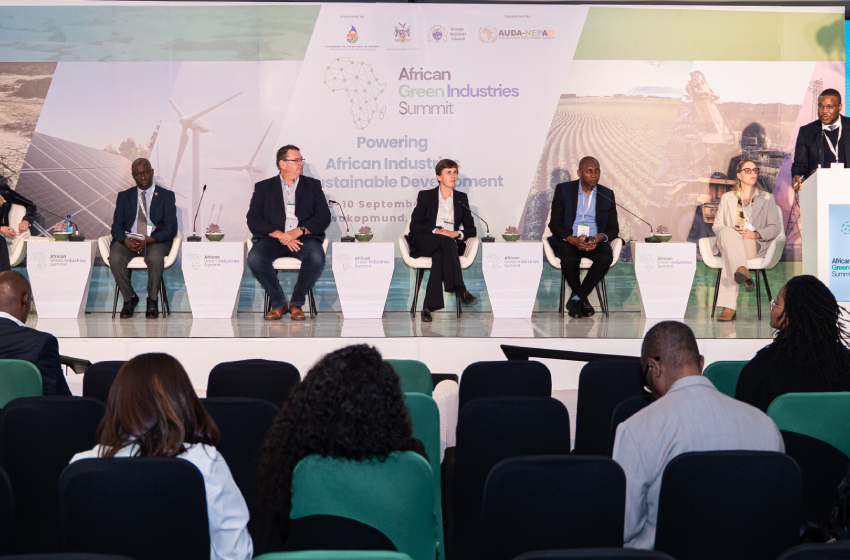
Taking the Summit’s primary stage, GET.transform convened a flagship panel titled “Unlocking Power Systems for Africa’s Green Industrial Growth.” Moderated by Emmanuel B Muzingwani of the EU-GET.transform Country Window Namibia, the high-level dialogue brought together key sector leaders, including the regulator -Electricity Control Board (ECB), development finance -KfW Development Bank, Namibia Green Hydrogen Programme (NGHP), the Renewable Energy and Industry Association of Namibia (REIAoN), local and international energy experts.
GIZ-HOSTED PANEL: GET.transform technical panel discussion on
Unlocking Transmission for Africa’s Green Industrial Growth. Photo: NEA/AGIS
The session focused on synchronising energy supply with long-term industrial demand. The key outcome focused on establishing forward-looking system readiness to safely integrate bulk renewable energy and connect large-scale industrial loads. In high-potential development corridors across Southern Africa, world-class renewable resources require forward-looking planning frameworks to ensure clean power reaches large-scale industrial loads efficiently.
GET.transform highlighted how technical assistance is actively advancing system readiness through:
- Southern Corridor Feasibility Studies and Hosting Capacity Assessments: Mapping grid capabilities to safely integrate variable renewable energy at scale.
- Namibia Integrated Resource Planning and Namibia Energy Outlook: Aligning long term energy plans with future industrial demand trajectories and long-term energy systems modeling.
- Regional Market Access: Leveraging Southern African Power Pool (SAPP) Master Energy Plan -to support regional interconnectors
Financial Architecture: Unlocking Capital for Green Hydrogen via S-TIP
The Green Hydrogen Business Alliance of GIZ, operating under the Global Energy Transformation Programme (GET.pro), convened an executive roundtable titled “Financing the Green Markets of the Future.” Co-led alongside the NGHP, the session brought together commercial banks, non-banking financial institutions, and international development partners to operationalise Namibia’s commitments under the Climate Investment Fund’s Industrial Decarbonisation Programme (CIF IDP).
Key outcomes focused on four strategic financial pillars:
- Reducing Capital Costs: Blending concessional capital to lower the Weighted Average Cost of Capital (WACC) and reduce the Levelised Cost of Ammonia (LCOA).
- Early-Stage Funding: Closing the project preparation funding gap for local developers.
- Flexible Bankability Terms: Securing longer tenors, grace periods, and standstill provisions tailored to project sponsors.
- Intermediated Finance via S-TIP: Engaging local commercial banks through the Sectoral Transformation Investment Plan (S-TIP) to strengthen local supply chain enterprises and build domestic capacity.
FINANCING GREEN MARKETS: Financial institutions at the Green Hydrogen Business Alliance Roundtable. Photo: NEA/AGIS
Export Readiness: Facilitating CBAM Compliance for exporter oriented installations
Trade frameworks are shifting rapidly, and the European Union’s Carbon Border Adjustment Mechanism (CBAM) presents both compliance requirements and export opportunities for African industry. GIZ, together with a technical expert from EU-based consulting firm CO2 IQ, hosted a session detailing CBAM’s monitoring, reporting, and verification (MRV) requirements during its definitive period.
The session featured a practical case study on HyIron, a Namibian pioneer producing green direct reduced iron (DRI). Supported by a GIZ-led MRV pilot, HyIron demonstrated how verified carbon transparency gives African manufacturers a competitive advantage in entering premium European low-carbon markets. This exercise feeds into the larger goal of producing a Namibia specific policy brief on CBAM, and provided Namibian stakeholders with an opportunity to provide input into the shape of this document.
Sector Coupling: E-Mobility, Agrivoltaics, and Digital Infrastructure Solutions
GIZ’s technical presence across the summit floor spanned multiple real-world applications designed to demonstrate practical execution:
E-Mobility Integration:
GET.transform expert contributed to main-stage panels on electric transport, addressing grid management, and regulatory frameworks required to integrate EV fleet loads into power system planning. The strong recommendation was the establishment of a National Technical Working Group on E-mobility and the development of an E-mobility Framework that assesses incentives and subsidies.
The GIZ Networking Lounge Pavilion:
Serving as the central hub at AGIS, the Pavilion implemented in partnership with Impact Tank Hub successfully saw cross-sector matchmaking between project developers, technology providers, and investors.
Agrivoltaics:
Specialised technical presentations showcased Agri photovoltaics (Agri-PV) as an innovative approach to address the challenges of the water-energy-food nexus in Namibia by integrating renewable energy and agriculture. The project team presented on the concept, sites with footage showcasing their implementation followed with explanations, along with their first results from production from both the agriculture lens and PV cost/carbon saving.
SUSTAINABLE AGRICULTURE: An Agrivoltaics demonstration at the GIZ Bevilion at AGIS. Photo: NEA/AGIS
GIZ Bevilion/stand:
The Agri-PV team showcased a small model that represents the work they do, helping those who came to visualise what they can expect to see at any of the pilot sites. At the stand various materials and information were made accessible for energy industry experts and future contributors of the sector concerning the different GIZ projects represented at the 2026 AGIS.
The Data Center Opportunity in Namibia
Data-centre development emerged as another dimension of the green-industrialisation discussion at AGIS. The German–Namibian hydrogen cooperation together with the South African–German Energy Partnership commissioned the German Energy Agency, to examine the data centre potential in South Africa and Namibia within Africa’s broader context.
Preliminary results of this study were presented at AGIS highlighting both the scale of the opportunity and the conditions required for African markets to compete. The study showed that Africa currently accounts for less than 1% of global data center capacity, with most facilities concentrated in South Africa, Egypt, Kenya and Nigeria, and much of the continent’s data still hosted offshore in Europe and North America.
Globally, supply is expanding fastest in the Americas and Asia-Pacific, while EMEA growth is focused on established European hubs and emerging Middle Eastern markets—raising competitive pressure for African locations. Namibia could attract international developers, create 1,000–5,000+ jobs at 500 MW capacity, advance digital sovereignty, position itself as a SADC digital hub, and leverage renewables for green growth.
Women in Green Hydrogen Networking
As part of Summit Day 1 the Women in Green Hydrogen (WiGH) hosted an evening reception for delegates to further engage in a more relaxed setting.
During the networking session the WiGH Namibia team provided insights into the organisation’s mandate and provided updates on the ongoing mentorship program. A key note address was provided by Dr. Rebecca Masermule, the Programme Director for Green Hydrogen within the Just Energy Transition Implementation Plan (JET IP) Programme Management Office (PMO). Operating under South Africa’s Industrial Development Corporation (IDC).
The Path Forward
AGIS 2026 demonstrated that Africa’s green transition requires both overarching strategy and deep technical execution. Through placing integrated technical assistance at the top of the agenda, GET.transform and GIZ continue to establish the technical blueprint required to turn Africa’s renewable potential into enduring, large-scale industrial prosperity.