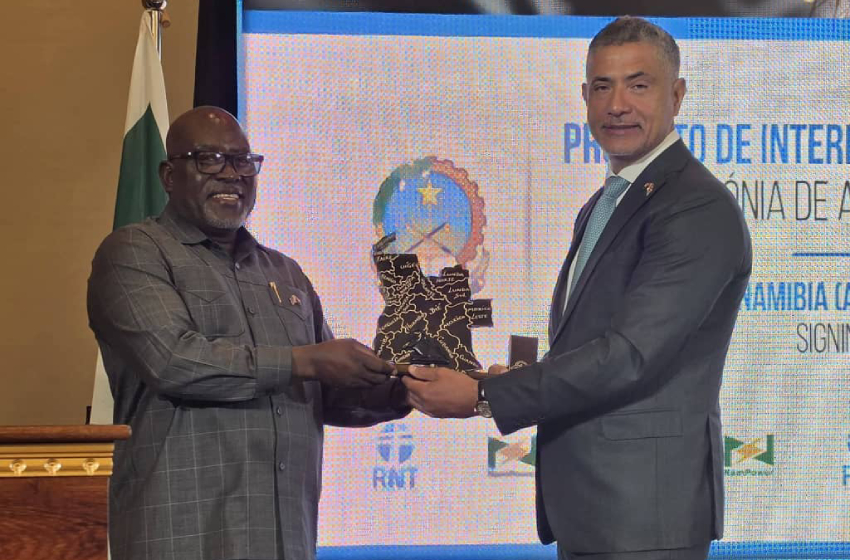
NamPower and Angola’s Rede Nacional de Transporte de Electricidade (RNT) have signed a Joint Development Agreement (JDA) for the development of the Angola-Namibia Power Interconnector Project (ANNA).
The two utilities also signed a bilateral Power Purchase Agreement (PPA), which establishes the technical, institutional, and commercial framework for the implementation of the ANNA Project.
The ANNA Interconnector Project is estimated to cost N$941 million (about US$52.3 million) to implement, and is scheduled for completion in 2029.
The Namibian Cabinet in February approved the development of the ANNA Project as a strategic infrastructure investment by the Ministry of Industries, Mines and Energy (MIME), through NamPower. The approval was followed by an Inter- Governmental Memorandum of Understanding (IGMoU) between MIME and its Angolan counterpart.
The development of the ANNA Project forms part of NamPower’s strategic initiatives as part of its Integrated Strategy and Business Plan (2026 – 2030) and is in line with the National Integrated Resource Plan (NIRP). Cabinet also endorsed the mobilisation of funding through the National Energy Fund (NEF) to cover Namibia’s share of capital costs, in line with the NEF mandate to support infrastructure that improves energy access and affordability.
POWERLINES
The project entails the construction of a 166 km (30 km in Namibia) 400 kV line between Kunene (Namibia) and Cahama (Angola) substations, including 400 kV line feeder bays, 400kV/330 kV transformation and an SVC at Kunene Substation.
It is further supported by the construction of a 270 km transmission line between Omatando and Otjikoto substations. The infrastructure expansion projects aim to facilitate the establishment of a transmission corridor between Angola and Namibia and connection of RNT-EP in Angola to the Southern African Power Pool (SAPP) grid to become an operating member.
NamPower Managing Director, Kahenge Haulofu, said the partnership represents the two utilities’ shared commitment to regional integration, energy security, and sustainable economic development, in alignment with the strategic priorities of both governments.
As energy demand across the SADC region continues to rise, coupled with persistent supply constraints, Haulofu said the ANNA Project “creates an opportunity to optimise and share our respective energy resources more effectively, thereby supporting the evolving needs of SAPP and contributing to regional energy security.”
ENERGY SECURITY
Namibia’s Minister of Industries, Mines and Energy, Modestus Amutse, who graced the signing ceremony in Luanda, Angola on 14 April, said the implementation of the ANNA Project signifies the commitment by the two countries to the cooperation in the energy sector and to promote the common vision of regional integration, energy security, and sustainable development.
“The ANNA Project is not merely a transmission line; it is a strategic instrument that will connect our economies, strengthen our institutions, and improve the lives of our people. By linking Angola to the Southern African Power Pool, the project enhances regional connectivity and unlocks the full potential of cross-border electricity trade,” said Amutse.
The Minister said for Namibia, the project was of vital importance. “As a country with growing energy demand, securing reliable, affordable, and sustainable electricity supply remains a national priority. The ANNA Project will play a key role in diversifying our energy mix, reducing supply risks, and supporting long-term economic development,” he said.
MUTUAL BENEFIT
Amutse reiterated that the project also creates an opportunity for Angola to further leverage its significant generation capacity, particularly from renewable and hydro resources, for the benefit of the region, exemplifying the principles of mutual benefit and shared prosperity.
“Our focus must now move to implementation. I encourage all parties to maintain momentum, ensure effective coordination, and strictly follow the agreed timelines to successfully deliver this project. As governments, we remain fully committed to providing the necessary support and oversight to ensure that this strategic initiative is implemented efficiently and delivers tangible results,” said the Namibian Energy Minister.
João Baptista Borges, Angola’s Minister of Water and Energy, said it was important to highlight that the implementation of the ANNA Project was coordinated with the Huíla–Cunene Interconnection Project (PIHC), also authorised by the Angola Presidential Decree No. 96/26 of March 20.
He said the PIHC aims to strengthen the electricity transmission network in southern Angola, serving as a condition precedent for the ANNA Project.
“This national project will allow for the expansion of electrification in the provinces of Huíla and Cunene, including the supply to the town of Xangongo and the reinforcement of the Ondjiva power system, ensuring that the benefits of the infrastructure translate directly into improved energy supply for the populations in the south of the country,” said Borges.