By Paulus Mulunga
Namibia’s renewable energy sector is entering a transformative era.
As the country accelerates its transition toward cleaner energy sources and positions itself as a future green hydrogen hub, large-scale renewable energy projects are becoming increasingly important in developing local technical capacity and industrial expertise. One such landmark development is the 100MW Sores |Gaib Solar Power Plant near Rosh Pinah — currently Namibia’s largest solar PV project under construction.
For Lights Systems Namibia (LSN), participation in this project represents far more than just another contract. It marks a significant milestone in the company’s growth journey and a major step forward in the development of local expertise in utility-scale renewable energy infrastructure.
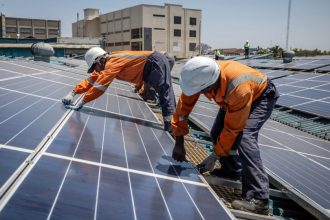
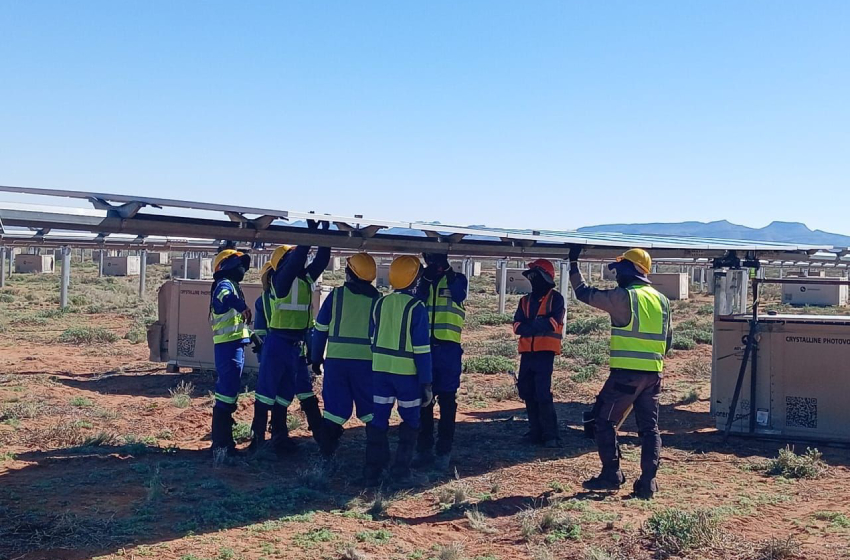
LSN was subcontracted by China Jiangxi International Economic and Technical Cooperation Namibia Ltd to perform tracking system and PV module installation works on the project. The contract scope included Engineering, Procurement and Construction (EPC)-related installation activities associated with the solar tracking systems and PV modules.
While LSN has previously been involved in the refurbishment of two smaller 5MW solar plants, the Sores |Gaib project introduced the company to an entirely different level of technical execution, project coordination, and operational discipline. The scale, complexity, and standards associated with a 100MW utility-scale solar park have provided invaluable experience that cannot be replicated on smaller projects.
One of the most important lessons gained from the project has been the significance of comprehensive health, safety, security, and environmental (HSSE) management systems. Utility-scale energy projects operate under stringent safety requirements, and the Sores |Gaib Solar Power Plant is no exception. From the beginning of the project, LSN was exposed to the process of developing and implementing detailed safety files, risk assessments, method statements, personnel management procedures, and compliance documentation.
This experience has fundamentally strengthened the company’s understanding of how critical health and safety management is within large infrastructure projects. On projects of this magnitude, safety is not merely a compliance requirement — it becomes part of the project culture. Every activity must be planned carefully, hazards identified proactively, and mitigation measures implemented systematically before work can proceed.
For many local contractors, one of the biggest challenges when transitioning from small commercial installations to utility-scale projects is adapting to the level of documentation and operational structure required. Through the Sores |Gaib project, LSN gained first-hand experience in aligning its internal systems with international EPC standards and project management protocols. This included workforce coordination, reporting systems, quality control processes, toolbox talks, safety inductions, inspection procedures, and detailed site planning.
The project also exposed the company to the realities of managing large teams and operating within highly coordinated construction schedules. Utility-scale projects involve multiple contractors, suppliers, engineers, consultants, and stakeholders working simultaneously under strict timelines. This requires clear communication, efficient resource allocation, and disciplined execution to avoid delays and maintain productivity.
Working within such an environment has significantly improved LSN’s project management capabilities. The company has developed a deeper understanding of planning methodologies, construction sequencing, logistics coordination, and workforce supervision at scale. These are critical skills that will be essential as Namibia continues to attract larger renewable energy and green industrial projects.
Another important aspect of the project has been exposure to advanced solar tracking systems. Unlike smaller fixed-tilt installations, large utility-scale solar parks increasingly rely on tracking technology to optimize energy yield and improve overall plant performance. Installing and working with these systems has enhanced the technical competence of LSN’s installation teams and provided practical experience with technologies commonly used in international utility-scale solar developments.
Beyond technical skills, the project has reinforced the importance of professionalism, accountability, and compliance in the renewable energy sector. International developers and financiers expect projects to meet high standards in quality assurance, environmental management, worker safety, and execution discipline. Participation in the Sores |Gaib Solar Power Plant has therefore helped position LSN to better understand the expectations associated with globally financed energy infrastructure projects.
Importantly, the knowledge and experience gained from this project extends beyond solar PV alone. Namibia’s emerging green hydrogen industry will require significant renewable energy infrastructure, including large-scale solar and wind generation facilities, battery energy storage systems (BESS), substations, transmission infrastructure, and industrial support services. The ability of local companies to participate meaningfully in these projects will depend heavily on whether they possess the technical competence and project execution experience required by international developers.
For LSN, the Sores |Gaib Solar Power Plant has become an important stepping stone toward that future. The project has demonstrated that local Namibian companies can contribute meaningfully to large-scale renewable energy developments when given the opportunity. More importantly, it has shown that local participation creates long-term value through skills transfer, operational exposure, and capacity development.
As Namibia continues to position itself as a leader in renewable energy and green hydrogen development in Africa, projects such as Sores-Gaib play a crucial role in preparing local companies for future participation in the sector. The experience gained today will determine the competitiveness of Namibian companies tomorrow.
LSN remains committed to growing its technical expertise, strengthening its operational systems, and contributing toward Namibia’s renewable energy transition. The lessons learned on the 100MW Sores-Gaib Solar Power Plant will continue to shape the company’s growth trajectory for years to come.
More importantly, the project serves as a reminder that renewable energy development is not only about generating electricity — it is also about developing local industries, empowering local contractors, and building a sustainable skills base that can support Namibia’s long-term industrial ambitions.
The future of Namibia’s energy sector will depend not only on the projects being developed, but also on the local capacity being built alongside them. For Lights Systems Namibia, the journey at Sores |Gaib is only the beginning.