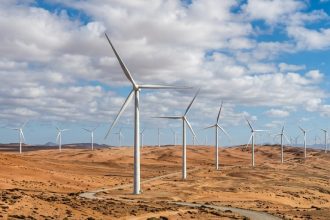
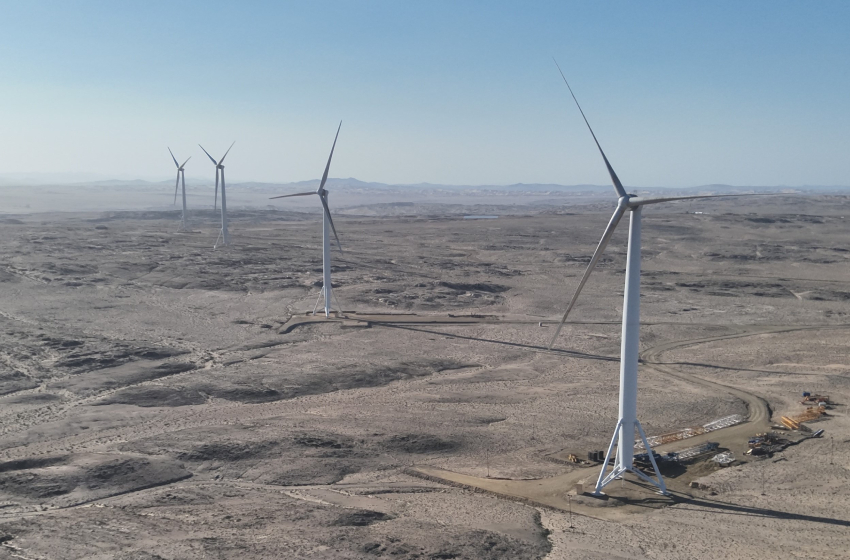
Construction is going full speed at InnoVent’s N$1.8 billion, 44MW Diaz Wind Farm just outside Lüderitz, with the plant earmarked to be commissioned in May 2026.
All civil engineering works, road construction, platform preparations are nearing hand-over and the erection of wind turbines is well underway. So far, four of the 11 turbines have been installed, each with a capacity of 2 megawatts (MW). Seven turbines with a capacity of 6MW each are currently being assembled. In total the Diaz Wind Farm will have a rated capacity of 50MW, which will represent over 200GWh/year, equivalent to the consumption of 40,000 households. This represents about 6% of Namibia’s current electricity consumption.
The wind farm is located in the Tsau // Khaeb National Park (formerly Sperrgebiet).
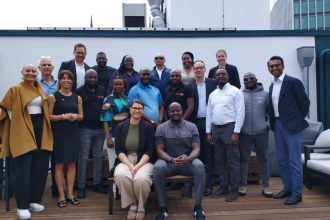
On 29 October, InnoSun, the Namibian subsidiary of InnoVent, a French renewable energy developer, took a high level delegation on a site visit to the Diaz Wind Farm site. The delegation consisted of officials from the Ministry of Industry, Mines & Energy, the Electricity Control Board (ECB), NamPower, French Embassy, finance institutions, and contractor companies. The mission was for the delegation to experience first-hand the progress of the installation works and to get an understanding of the technology that InnoVent is bringing to Namibia.
FIRST WIND PLANT
InnoVent Founder and Chief Executive Officer, Grégoire Verhaeghe, said he was honoured that his Namibian company, InnoSun, was the first to install grid-connected wind turbines at Ombepo, also in Lüderitz, back in 2017.
“I am blessed to have installed three wind turbines at Ombepo, producing 5MW energy for the past seven years. That was a pilot (project) on medium voltage. Diaz Wind Farm is a pilot project on high voltage. From here we (Diaz) are part of the national grid and we are directly connected to Kokerboom via the 132 kV line, which is part of the backbone of Namibia’s electricity supply chain,” he said.
The two transformers required to connect the wind farm to NamPower’s grid are installed on the Diaz site and currently being tested.
ECB Chief Executive Officer Robert Kahimise, who was part of the delegation that visited Diaz, expressed satisfaction with the ongoing construction work progress at the wind farm.
He emphasised the importance of officials from the regulator to visit and inspect the sites of power plants to verify compliance.
“The reason why we are here is to experience and to actually attest to the work that has been done to date. Therefore, our mandate includes inspecting in person instead of only working from the office. So, that’s why we are here with our delegation as a regulator to verify,” said Kahimise.
He said the ECB welcomed the development of renewable energy plants in Namibia as every locally-generated electricity unit, that is far below the cost of imported power, is welcome.
REALISING A DREAM
“We are here realising the government’s dream of connecting the unconnected and making electricity affordable to Namibian consumers,” said Kahimise.
The ECB CEO said Namibia’s future lies in achieving an optimal energy mix that combines large-scale solar and wind power, complemented by battery storage systems to ensure a stable base load.
Diaz will be the largest single wind plant built by InnoVent so far. The group has built more than 500MW of wind turbines throughout the world to date, with a 34MW wind power plant built in Morocco currently being the largest.
Yoann Picard, the Manager in charge of the Engineering, Procurement and Construction (EPC) at the Diaz Wind Farm, described the project as an experimental “next generation” wind farm.
He said the rock anchored foundation being used at Diaz, in comparison with the classic gravity foundation, like those at Ombepo, are five times less volume of concrete.
“At Diaz we have reduced to the minimum use of concrete to improve the carbon foot print of the project and mitigate technical risks associated with mass concrete casting,” said Picard.
The Nabrabase tripod tower foundation structure, developed by Spanish company, Nabrawind Technologies, supports the XE93 2MW turbines already installed at Diaz, using almost 10 times less concrete than conventional turbine foundations.
NEW TECHNOLOGY
“The Blade Runner technology (developed by Nabrawind), allows the installation (and replacement in future) of the turbine blades without the need of a high capacity crane with extended boom. These types of cranes are not available in Namibia. Thanks to this technology, we will be able to handle the maintenance operations by utilizing the lifting equipment already in Namibia,” said Picard.
The Total Self Erecting System (TSES), also developed by Nabrawind, is being used for the installation of the Goldwind GW165-6MW turbines at Diaz. The system is designed to allow the heavy and sensitive lifting to take place at low altitude (35 meters) and then erect the wind turbine from its base upward by adding the tower sections after.
Picard said this was a complete change of process in comparison with standard practice in the industry.
“The TSES is designed for the challenging construction sites, with the strongest wind conditions. It enables us to reduce the configuration and capacity of the crane required and optimises the workable wind windows as it can operate in wind speeds of up to 54km/h. For conventional lifting at high altitude we are limited to 30km/h wind speeds,” said the Diaz EPC Manager.